

Complex abstract thinking in the classroom
Article Sidebar
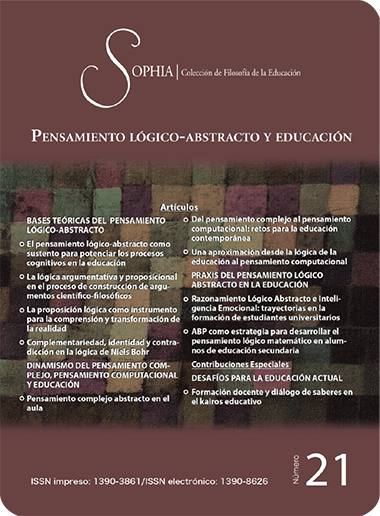
Main Article Content
Abstract
Currently it prevails in our society the Cartesian linear thinking. This has resulted in today’s world a profound social, cultural and political crisis. Education also is crossed by this crisis. The changes that have occurred in the world transitioned from a long industrial period to a different one characterized by information, communications, mobility, development of knowledge and complexity, has not yet had its counterpart in the way of understanding.
The current Cartesian or engineering paradigm prevents current generations know how to live in contemporary society. This has meant a daunting planetary damage that can put into question even human life. In necessary, then the construction of a new way of thinking.
One of the most important academic tasks today is to try to determine the cognitive deficits of humanity and how they are transferred to education. At the same time, the mission of overcoming them, to discover how to set up a new way of thinking, to train, to educate, a new paradigm
epistemology that allows us to understand our planetary home through a systemic, holistic paradigm, logical arises, transdisciplinary and complex
From this perspective it is possible to cause the momentous changes that education and training of citizens need to deliver a complex vision and quality to children, young students and professionals today are emerging from universities
Article Details
Authorship: The list of authors signing must include only those people who have contributed intellectually to the development of the work. Collaboration in the collection of data is not, by itself, a sufficient criterion of authorship. "Sophia" declines any responsibility for possible conflicts arising from the authorship of the works that are published.
Copyright: The Salesian Polytechnic University preserves the copyrights of the published articles, and favors and allows their reuse under the Creative Commons Attribution-NonCommercial-ShareAlike 3.0 Ecuador license. They may be copied, used, disseminated, transmitted and publicly displayed, provided that: i) the authorship and the original source of their publication (journal, editorial and work URL) are cited; (Ii) are not used for commercial purposes; Iii) mention the existence and specifications of this license.
References
2001 El paradigma complejo. Un cadáver exquisito. Panamá: Universidad Interamericana de Educación a Distancia de Panamá.
BUGANZA, Jorge y Sarquis, Jacob
2009 La teoría del conocimiento transdisciplinar a partir del Manifiesto de Basarab Nicolescu. Argentina. Universidad Nacional de San Luis Fundamentos en Humanidades –Año X – Número I.
CAMPBELL Jeremy
1997 La máquina increíble. Santiago: Fondo de Cultura Económica.
FREIRE, Paulo
1969 La educación como práctica de la libertad. España: Siglo XXI.
2012 Educación problematizadora. En: http://futuroseducadoresvedia.blogspot.com/2012/11/educacion-problematizadora.html [En línea].
HAWKING, Stephen
2004 A hombros de gigantes Las grandes obras de la Física y la Astronomía. Edición de Stephen Hawking. Barcelona: Crítica.
2008 La Teoría del Todo. El origen y el destino del Universo. Debate. Buenos Aires.
LUPASCO, Stéphane
1951 Le principe d’antagonisme et la logique de l’énergie. Prolégomènes à une science de la contradiction. Paris: Hermann & Co.
MARTÍNEZ, Miguel
2003 Transdisciplinariedad un enfoque para la complejidad del mundo. En: Revista Visión docente con-ciencia, No. 1 Julio. Disponible en: http://es.slideshare. net/edelinbravo29/1-lg-transdisciplinariedad-miguel-martinez-migulez [En línea].
MATURANA, Humberto & VARELA, Francisco
1995 De máquinas y seres vivos. Autopoiésis: la organización de lo vivo Santiago de Chile: Editorial Universitaria.
MATURANA, Humberto & NISIS, Sima
1999 Transformación en la convivencia. Santiago de Chile: Dolmen.
MORIN, Edgar
1999 7 saberes. Traducción Mercedes Vallejo Gómez. México: Multiversidad
Mundo Real Edgar Morín.
NICOLESCU, Basarab
1996 La transdisciplinariedad. Manifiesto. México: Multiversidad Mundo Real Edgar Morín.
PIAGET, Jean, & INHELDER, Bärbel
1973 Memory and intelligence. Londres: Routledge y Kegan Paul.
PRIGOGINE, Ilya
2000 El nacimiento del tiempo. Barcelona: Tusquets Editores. VARELA, Francisco 2000 El fenómeno de la vida. Santiago de Chile: Ediciones Dolmen.
YANES, Jaime
2011 Paulo Freire, la “educación problematizadora” y los ambientes virtuales de aprendizaje”. En: http://www.pensarlopensado.com/2011/11/paulo-freirela-educacion.html [En línea].
2012 El caos, el orden y la escuela. En: http://www.pensarlopensado.com/2012/07/el-caos-el-orden-y-la-escuela.html [En línea].
2015 Complejidad y calidad de la educación. Santiago de Chile: Ediciones Ril.