

Assessment of generic competences of entrepreneurial behavior
Article Sidebar
Main Article Content
Abstract
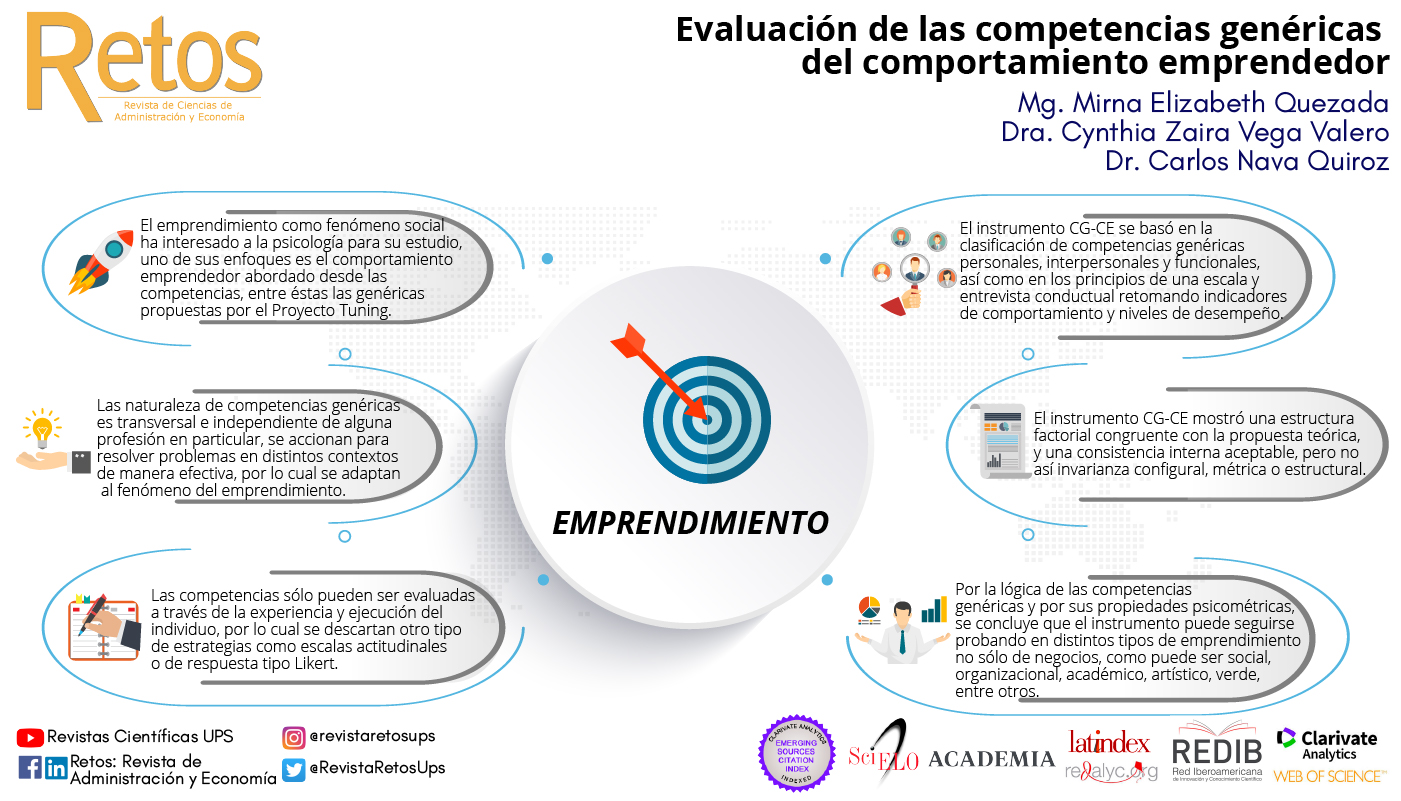
Entrepreneurship as a social phenomenon has interested psychology for its study, one of its approaches is the entrepreneurial behavior from the competences, among them the generic / transversal ones. However, an area of opportunity in the literature is the assessment of competences for their fundamental characteristics of observable and demonstrable behaviors through experience. The objective of this study was to design and test the psychometric properties of an instrument for measuring generic entrepreneurial competences. The study was cross-sectional and instrumental with a non-random sample of 142 participants. The instrument was based on a model of three categories of generic competences (personal, interpersonal, functional), as well as on the logic of a behavioral interview and behavioral scale; It was made up of 14 items with four performance gradients where the participant had to respond based on his experience. The Exploratory Factor Analysis yielded a theoretically congruent three-dimensional structure that explains 53.8% of the accumulated variance. The coefficients Alpha de Cronbach (?) y Omega de McDonald (?) showed adequate internal consistency higher than .80. No configuration, metric or structural invariance was detected between people who have or have not opened businesses. It is concluded that the instrument has the appropriate psychometric properties to continue testing in business entrepreneurs among other entrepreneurship contexts from the behavioral perspective oriented towards competencies.
Article Details
Authorship: The list of authors signing must include only those people who have contributed intellectually to the development of the work. Collaboration in the collection of data is not, by itself, a sufficient criterion of authorship. "Retos" declines any responsibility for possible conflicts arising from the authorship of the works that are published.
Copyright: The Salesian Polytechnic University preserves the copyrights of the published articles, and favors and allows their reuse under the Creative Commons Attribution-NonCommercial-ShareAlike 3.0 Ecuador license. They may be copied, used, disseminated, transmitted and publicly displayed, provided that: i) the authorship and the original source of their publication (journal, editorial and work URL) are cited; (Ii) are not used for commercial purposes; Iii) mention the existence and specifications of this license.
References
Baron, R. (2007). Behavioral and cognitive factors in Entrepreneurship: entrepreneurs as the Active element in new venture creation. Strategic Entrepreneurship Journal, 1, 167–182. https://doi.org/10.1002/sej.12
Batanero, J. M. F., & Rebollo, M. M. R. (2017). Competencias emprendedoras del alumnado de educación permanente de adultos en Andalucía. Percepción del profesorado. Educación XX1, 20(1), 253-275. https://doi.org/10.5944/educxx1.17511
Bilbao, N. S., & Vélez, A. L. L. (2015). Las competencias de emprendimiento social, COEMS: Aproximación a través de programas de formación universitaria en Iberoamérica. REVESCO. Revista de Estudios Cooperativos, (119), 159-182. http://dx.doi.org/10.5209/rev_REVE.2015.n119.49066
Bird B., & Schjoedt L. (2009) Entrepreneurial Behavior: Its Nature, Scope, Recent Research, and Agenda for Future Research. En Carsrud A., Brännback M. (eds.) Understanding the Entrepreneurial Mind. International Studies in Entrepreneurship, vol 24. Springer, New York, NY. https://doi.org/10.1007/978-1-4419-0443-0_15
Byrne, B. M. (2008). Testing for multigroup equivalence of a measuring instrument: A walk through the process. Psicothema, 20(4), 872-882.
Demchuk, A., Karavaeva, Y., Kovtun, Y., & Rodionova, S. (2015). Competencies, learning outcomes and forms of assessment: The use of Tuning Methodology in Russia. Tuning Journal for Higher Education, 3(1), 149-185. https://doi.org/10.18543/tjhe-3(1)-2015pp149-185
DeVellis, R. (2003). Scale development: theory and applications (second edition). Sage: London.
Do?an, C. D., & Uluman, M. (2017). A comparison of rubrics and graded category rating scales with various methods regarding raters’ reliability. Educational Sciences: Theory & Practice, 17, 631–651. http://dx.doi.org/10.12738/estp.2017.2.0321
Gámez-Gutiérrez, J. A. (2013). Emprendimiento y creación de empresas: teoría, modelos y casos. Bogotá: Ediciones Unisalle.
Gartner, W. B. (1988). “Who Is an Entrepreneur?” Is the Wrong Question. American Journal of Small Business, 12(4), 11–32. https://doi.org/10.1177/104225878801200401
Gartner W.B., Carter N.M. (2003) Entrepreneurial Behavior and Firm Organizing Processes. In: Acs Z.J., Audretsch D.B. (eds) Handbook of Entrepreneurship Research. International Handbook Series on Entrepreneurship, vol 1. Springer, Boston, MA. https://doi.org/10.1007/0-387-24519-7_9.
González, J., & Wagenaar, R. (2003). Tuning educational structures in Europe: Informe final fase uno. Universidad de Deusto. Universidad de Groningen.
Gruber, M., & MacMillan, I. C. (2017). Entrepreneurial Behavior: A Reconceptualization and Extension Based on Identity Theory. Strategic Entrepreneurship Journal, 11(3), 271–286. https://doi.org/10.1002/sej.1262
Gustafsson, V. (2006). Entrepreneurial decision-making: Individuals, tasks and cognitions. Cheltenham, England: Edward Elgar Publishing.
Hager, P., Gonczi, A., & Athanasou, J. (1994). General Issues about Assessment of Competence. Assessment & Evaluation in Higher Education, 19(1), 3–16. https://doi.org/10.1080/0260293940190101.
Hair, J. F., Anderson, R. E., Tatham, R. L., & Black, W. C. (1999). Análisis multivariante (Vol. 491). Madrid: Prentice Hall.
Hjorth, D., & Holt, R. (2016). It's entrepreneurship, not enterprise: Ai Weiwei as entrepreneur. Journal of Business Venturing Insights, 5, 50-54. https://doi.org/10.1016/j.jbvi.2016.03.001
Hodzic, S. (2016). Increasing PhD students’ employability by focusing on the academic entrepreneurship. The analysis of the entrepreneurial competences. Tuning Journal for Higher Education, 3(2), 347-387. https://doi.org/10.18543/tjhe-3(2)-2016pp347-387.
Holley, A. C., & Watson, J. (2017). Academic entrepreneurial behavior: birds of more than one feather. Technovation, 64, 50-57. http://dx.doi.org/10.1016/j.technovation.2017.07.001
Huyghe, A., Knockaert, M., & Obschonka, M. (2016). Unraveling the “passion orchestra” in academia. Journal of Business Venturing, 31(3), 344-364. https://doi.org/10.1016/j.jbusvent.2016.03.002
Kerr, S. P., Kerr, W. R., & Xu, T. (2018). Personality traits of entrepreneurs: A review of recent literature. Foundations and Trends® in Entrepreneurship, 14(3) 279-356. http://dx.doi.org/10.1561/0300000080
Lloret-Segura, S., Ferreres-Traver, A., Hernández-Baeza, A., & Tomás-Marco, I. (2014). El análisis factorial exploratorio de los ítems: una guía práctica, revisada y actualizada. Anales de Psicología/Annals of Psychology, 30(3), 1151-1169. http://dx.doi.org/10.6018/analesps.30.3.199361
Luppi, E., Bolzani, D., & Terzieva, L. (2019). Assessment of transversal competencies in entrepreneurial education: a literature review and a pilot study. Form@ re-Open Journal per la formazione in rete, 19(2), 251-268. http://dx.doi.org/10.13128/formare-25114
Martín-Varés, L. O. (2006). Identificación de competencias: una estrategia para la formación en el Espacio Europeo de Educación Superior. Revista Complutense De Educación, 17(1), 101-118.
Matíz, F. J., & Mogollón-Cuevas, Y. (2008). La cadena de financiación: Una necesidad para el desarroll o económico y social a partir del emprendimiento. Revista Escuela de Administración de Negocios, (63), 59-72.
Messina, M., & Hochsztain, E. (2015). Entrepreneurial success factors: An exploratory study based on Data Mining Techniques. Tec Empresarial, 9(1), Pág. 30–40. https://doi.org/10.18845/te.v9i1.2206
Milfont, T. L., & Fischer, R. (2010). Testing measurement invariance across groups: Applications in cross-cultural research. International Journal of psychological research, 3(1), 111-130. https://doi.org/10.21500/20112084.857
Mitchelmore, S., & Rowley, J. (2010). Entrepreneurial competencies: a literature review and development agenda. International Journal of Entrepreneurial Behavior & Research, 16(2), 92–111. https://doi.org/10.1108/13552551011026995
Morris, M. H., Webb, J. W., Fu, J., & Singhal, S. (2013). A competency?based perspective on entrepreneurship education: conceptual and empirical insights. Journal of small business management, 51(3), 352-369. https://doi.org/10.1111/jsbm.12023
Obschonka, M., Moeller, J., & Goethner, M. (2019). Entrepreneurial passion and personality: the case of academic entrepreneurship. Frontiers in psychology, 9:2697. https://doi.org/10.3389/fpsyg.2018.02697
Organización Internacional del Trabajo (2014). Promoción de futuros emprendedores. Programa de Empresas Sostenibles. http://oit.org/wcmsp5/groups/public/---ed_emp/---emp_ent/---ifp_seed/documents/publication/wcms_185343.pdf
Ortiz-Valdés, S. (2020). Formación emprendedora universitaria: más allá de los mitos. Emprendimiento con sentido de propósito. México: Editorial Digital del Tecnológico de Monterrey.
Pituch, K. A., & Stevens, J. P. (2015). Applied multivariate statistics for the social sciences: Analyses with SAS and IBM’s SPSS. New York: Routledge. https://doi.org/10.4324/9781315814919
Salinas, F. & Osorio, L. (2012). Emprendimiento y Economía Social, oportunidades y efectos en una sociedad en transformación. CIRIEC-España, Revista de Economía Pública, Social y Cooperativa, 75, 128-151.
Ribes, E. (2006). Competencias conductuales: Su pertinencia en la formación y práctica profesional del psicólogo. Revista Mexicana de Psicología, 23(1), pp. 19-26.
Rotefoss, B., & Kolvereid, L. (2005). Aspiring, nascent and fledgling entrepreneurs: an investigation of the business start-up process. Entrepreneurship & Regional Development, 17(2), 109-127. https://doi.org/10.1080/08985620500074049
Salgado, J. F., Moscoso, S., & Gorriti, M. (2004). Investigaciones sobre la entrevista conductual estructurada (ECE) en la selección de personal en la Administración General del País Vasco: Meta-análisis de la Fiabilidad. Revista de Psicología del Trabajo y de las Organizaciones, 20(2), 107-139.
Schelfhout, W., Bruggeman, K., & De Maeyer, S. (2016). Evaluation of entrepreneurial competence through scaled behavioural indicators: Validation of an instrument. Studies in Educational Evaluation, 51, 29-41. http://dx.doi.org/10.1016/j.stueduc.2016.09.001
Sireci, S. G. (2007). On validity theory and test validation. Educational Researcher, 36(8), 477-481. https://doi.org/10.3102/0013189X07311609
Teague, B. T., & Gartner, W. B. (2017). Toward a Theory of Entrepreneurial Behavior. In G. Ahmetoglu, T. Chamorro?Premuzic, B. Klinger, T., Karcisky (Eds.), The Wiley Handbook of Entrepreneurship, 71–94. https://doi.org/10.1002/9781118970812.ch4
Tornikoski, E., & Maalaoui, A. (2019). Critical reflections–The Theory of Planned Behaviour: An interview with Icek Ajzen with implications for entrepreneurship research. International Small Business Journal, 37(5), 536-550. https://doi.org/10.1177/0266242619829681
Van de Schoot, R., Lugtig, P., & Hox, J. (2012). A checklist for testing measurement invariance. European Journal of Developmental Psychology, 9(4), 486–492. https://doi.org/10.1080/17405629.2012.686740
Ventura-León, J. L., & Caycho-Rodríguez, T. (2017). El coeficiente Omega: un método alternativo para la estimación de la confiabilidad. Revista Latinoamericana de Ciencias Sociales, Niñez y Juventud, 15(1), 625-627.
Villa, A., & Poblete, M. (2007). Aprendizaje basado en competencias. Una propuesta para la evaluación de las competencias genéricas. Bilbao: Mensajero/ICE Universidad de Deusto.
Wagner J. (2006) Nascent Entrepreneurs. En: Parker S. (ed) The Life Cycle of Entrepreneurial Ventures. International Handbook Series on Entrepreneurship, vol 3. Springer, Boston, MA. https://doi.org/10.1007/978-0-387-32313-8_2
Yanchatuña, E. M., Badillo, L. R., & Urrutia, D. M. (2018). El emprendimiento desde la perspectiva de las incubadoras de empresas: un análisis comparado por países. Bolentín de Coyuntura, 1(18), 8-13