

Caracterização do óleo da semente Sacha Inchi (plukenetia volubilis) do cantão de San Vicente, Manabí, Equador, obtido por processos de extrusão não térmicos
Barra lateral de artigos
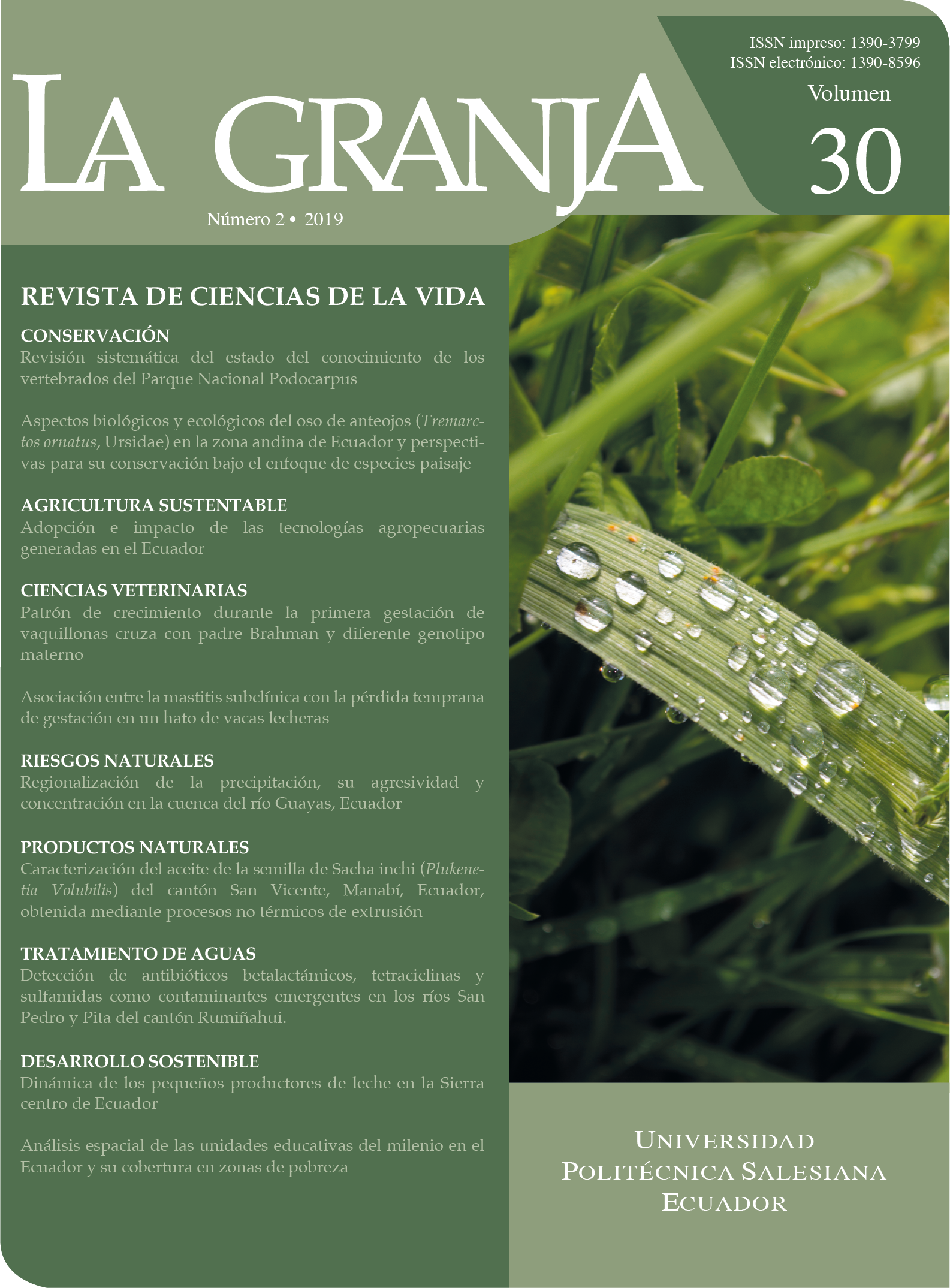
Conteúdo do artigo principal
Resumo
Sacha Inchi (Volubilis plukenetia) é uma planta nativa do Perú. O seu fruto contém sementes oleaginosas com alto teor de ácidos graxos poliinsaturados, dos quais se destacam os ômegas 3 e 6. Para a extração do óleo, foi utilizado o método de compressão por extrusão, utilizando um parafuso sem fim que aumenta a pressão da massa, separando assim o óleo contido na semente.
Para tal, utilizou-se um extrator experimental adaptado para extrair e obter o óleo a temperatura ambiente. Com a finalidade de estabelecer as características físico-químicas da semente, realizaram-se análises de umidade, fibra, cinza, gordura e proteína.
Uma vez extraído o óleo, foram calculados os rendimentos e realizadas análises de: índice de acidez, densidade relativa, índice de iodo, índice de peróxido e perfil de ácidos graxos. Os resultados foram comparados com análises realizadas no óleo da mesma espécie, porém provenientes de diferentes áreas de cultivo do Peru, e com óleos de peixe e azeite que são conhecidos por terem alto teor de ácidos graxos. Como resultado obtido, o óleo de Sacha Inchi possui um alto teor de ácidos graxos poliinsaturados e o método de extração influencia na qualidade do produto.
Detalhes do artigo
Universidad Politécnica Salesiana of Ecuador preserves the copyrights of the published works and will favor the reuse of the works. The works are published in the electronic edition of the journal under a Creative Commons Attribution/Noncommercial-No Derivative Works 3.0 Ecuador license: works can be copied, used, disseminated, transmitted and publicly displayed.
The undersigned author partially transfers the copyrights of this work to Universidad Politécnica Salesiana of Ecuador for the printed edition.
Referências
Carrillo Fernández, L., Dalmau Serra, J., Martínez Álvarez, J. R., Solà Alberich, R., & Pérez Jiménez, F. (2011). Grasas de la dieta y salud cardiovascular. Atención Primaria, 43(3), 157.e1-157.e16. Online: https://bit.ly/2KnftZl
Castaño T, D. L., G, M. del P. V., P, E. M., A, J. J. M., & Joli, J. E. (2012). Fatty Acid Composition of Inca Peanut (Plukenetia volúbilis Linneo) and its Relationship with Vegetal Bioactivity. Revista Chilena de Nutricion, 39(11), 45–52. Online: https://bit.ly/31rIJE8
Cebi, N., Yilmaz, M. T., Sagdic, O., Yuce, H., & Yelboga, E. (2017). Prediction of peroxide value in omega-3 rich microalgae oil by ATR-FTIR spectroscop combined with chemometrics. Food Chemistry, 225, 188–196.Online: https://bit.ly/2YzxyMG
Chirinos, R., Zuloeta, G., Pedreschi, R., Mignolet, E., Larondelle, Y., & Campos, D. (2013). Sacha inchi (Plukenetia volubilis): A seed source of polyunsaturated fatty acids, tocopherols, phytosterols, phenolic compounds and antioxidant capacity. Food Chemistry, 141(3), 1732–1739. Online: https://bit.ly/2ZLntsC
Cisneros, F. H., Paredes, D., Arana, A., & Cisneros-Zevallos, L. (2014). Chemical composition, oxidative stability and antioxidant capacity of oil extracted from roasted seeds of Sacha-inchi (Plukenetia volubilis L.). Journal of Agricultural and Food Chemistry, 62(22), 5191–5197. Online: https://bit.ly/2ZHDkrV
Fanali, C., Dugo, L., Cacciola, F., Beccaria, M., Grasso, S., Dachà, M., … Mondello, L. (2011). Chemical characterization of Sacha inchi (Plukenetia volubilis L.) oil. Journal of Agricultural and Food Chemistry, 59(24), 13043–13049. Online: https://bit.ly/2KlW1Mw
FAO/OMS. Norma para aceites vegetales especificados, Codex Alimentarius § (2015). Online: https://bit.ly/2M79PN9
Gutiérrez, L. F., Rosada, L. M., & Jiménez, Á. (2011). Chemical composition of Sacha Inchi (Plukenetia volubilis L.) seeds and characteristics of their lipid fraction. Grasas y Aceites, 62(1), 76–83. Online: https://bit.ly/2yKSWPs
JAMES, c. s. (1995). Analytical Chemistry of Foods. New York: Chapman and Hall publishers. Online: https://bit.ly/2GVhR7E
Maurer, N. E., Hatta-Sakoda, B., Pascual-Chagman, G., & Rodriguez-Saona, L. E. (2012). Characterization and authentication of a novel vegetable source of omega-3 fatty acids, sacha inchi (Plukenetia volubilis L.) oil. Food Chemistry, 134(2), 1173–1180. Online: https://bit.ly/2GT985G
Muangrat, R. (2018). Screw press extraction of Sacha inchi seeds?: Oil yield and its chemical composition and antioxidant properties, (March), 1–10. Online: https://bit.ly/2GTgiqG
Nascimento, V. L. V., Bermúdez, V. M. S., Oliveira, A. L. L., Kleinberg, M. N., Ribeiro, R. T. M., Abreu, R. F. A., & Carioca, J. O. B. (2015). Characterization of a hydrolyzed oil obtained from fish waste for nutraceutical application. Food Science and Technology, 35(2), 321–325. Online: https://bit.ly/2GWTyWK
Paucar-Menacho, L. M., Salvador-Reyes, R., Guillén-Sánchez, J., Capa-Robles, J., & Moreno-Rojo, C. (2015). Comparative study of physical-chemical features of sacha inchi oil (Plukenetia volubilis l.), olive oil (Olea europaea) and fish oil. Scientia Agropecuaria, 279–290. Online: https://bit.ly/2MOwYDw
Piscopo, A., De Bruno, A., Zappia, A., Ventre, C., & Poiana, M. (2016). Characterization of monovarietal olive oils obtained from mills of Calabria region (Southern Italy). Food Chemistry, 213, 313–318. Online: https://bit.ly/2YULHPE
Racine, N. M., Watras, A. C., Carrel, A. L., Allen, D. B., Mcvean, J. J., Clark, R. R., … Schoeller, D. A. (2010). Effect of conjugated linoleic acid on body fat accretion in overweight or. Journal of Clinical Nutrition, 91(1), 1157–1164.Online: https://bit.ly/2TemiPX
Rodríguez, M., Tovar, A., del Prado, M., & Torres, N. (2005). Mecanismos moleculares de los ácidos grasos poliinsaturados y sus beneficios en la salud. Rev Invest Clin., 57(3), 457–472. Online: https://bit.ly/2MOjc40
Romero Aroca, A. J. (2011). Caracterización y diferenciación de los aceites vírgenes de oliva de la comarca del Priorat (Tarragona), dentro del mercado global de aceites de la variedad “Arbequina.” Tesis. Online: https://bit.ly/2YwJqyV
Saiki, P., Kawano, Y., Van Griensven, L. J. L. D., & Miyazaki, K. (2017). The anti-inflammatory effect of: Agaricus brasiliensis is partly due to its linoleic acid content. Food and Function, 8(11), 4150–4158.Online: https://rsc.li/2yNoXXb
Strobel, C., Jahreis, G., & Kuhnt, K. (2012). Survey of n-3 and n-6 polyunsaturated fatty acids in fish and fish products. Lipids in Health and Disease, 11(October), 144. Online: https://bit.ly/2YUifgN
TAKEYAMA, E., & FUKUSHIMA, M. (2013). Physicochemical Properties of Plukenetia volubilis L. Seeds and Oxidative Stability of Cold-pressed Oil (Green Nut Oil). Food Science and Technology Research, 19(5), 875–882.Online: https://bit.ly/2KCNfJf
Wang, S., Zhu, F., & Kakuda, Y. (2018). Sacha inchi (Plukenetia volubilis L.): Nutritional composition, biological activity, and uses. Food Chemistry, 265(December 2017), 316–328. Online: https://bit.ly/2GTbrpm
H., V. D. T., J.E., T., P.C., L., F.A.J., M., & M.H., V. R. (1990). Effects of fish oil supplementation in rheumatoid arthritis. Annals of the Rheumatic Diseases, 49(2), 76–80. Online: https://bit.ly/2TgXW7X