

Relação entre mastite subclínica e perda precoce da gestação em rebanho de vacas leiteiras
Barra lateral de artigos
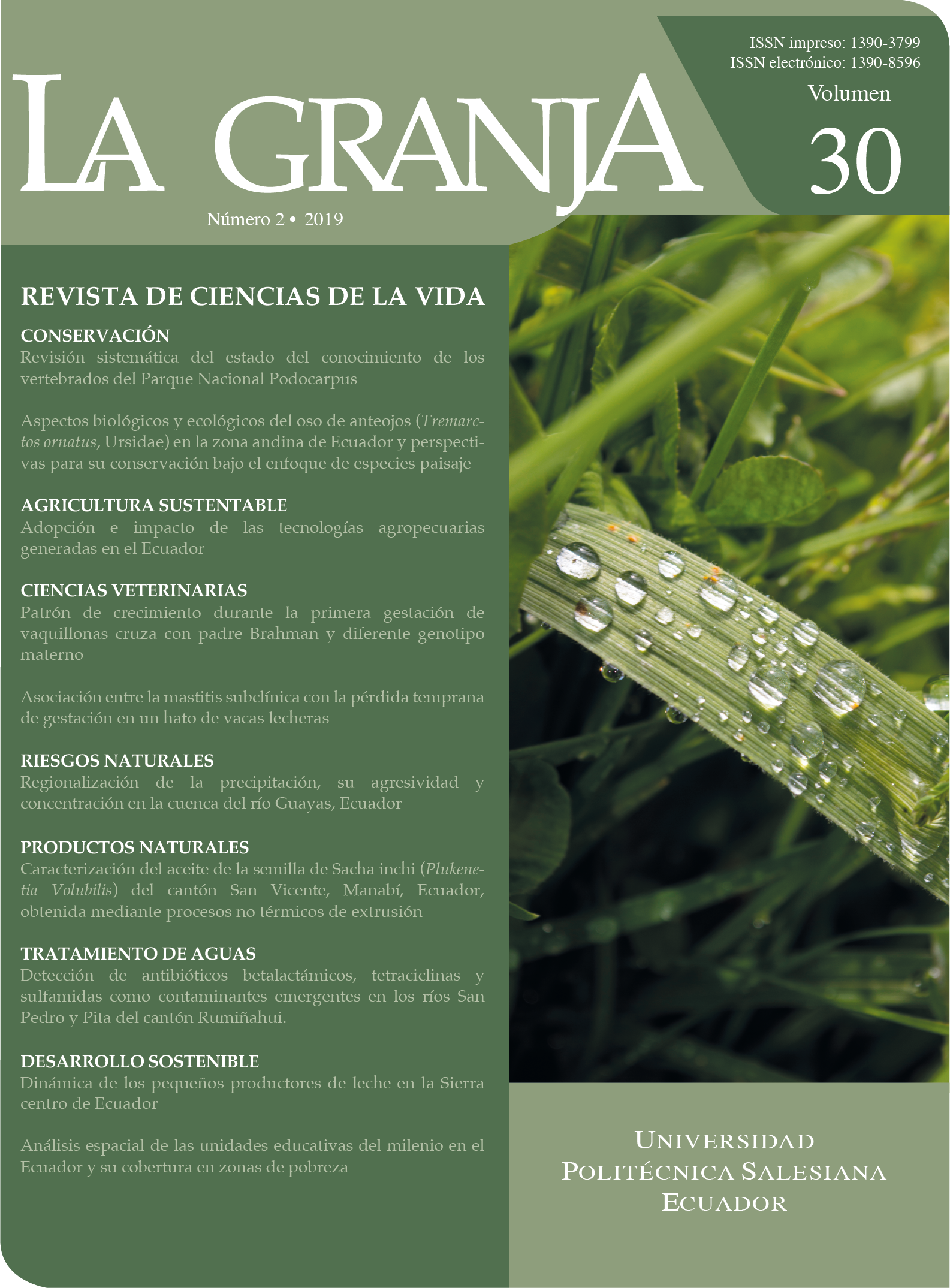
Conteúdo do artigo principal
Resumo
O objetivo do presente estudo foi avaliar a relação entre os diferentes graus de mastite subclínica e a perda precoce da gestação durante os primeiros 90 dias após o serviço em vacas leiteiras da raça Holandesa. A pesquisa foi realizada em uma fazenda de gado leiteiro localizada no Equador, na província de Pichincha, no cantão Mejía. Para o estudo, foram avaliados dados de 619 vacas no período de outubro de 2015 a outubro de 2016.
O Grupo Controle (CMT 0), foi composto por vacas que não apresentaram mastite subclínica até 90 dias após a inseminação artificial (IA). O grupo CMT T-1, vacas apresentando traços e grau 1 para o diagnóstico de mastite subclínica até 90 dias após a IA e o grupo CMT 2-3, vacas que apresentaram mastite subclínica graus 2 e 3 até 90 dias após a IA.
O diagnóstico de gestação foi realizado por ultrassonografia transretal entre 28 e 35 dias após a IA e o acompanhamento por ultrassonografia foi realizado aos 60 e 90 dias de gestação. Ocorreu 12% de perda gestacional entre 30 e 60 dias e 5% entre 60 e 90 dias.
Com esse resultado, foi evidenciada a relação entre mastite subclínica grau 2 e 3 com perda precoce da gestação (OR 2,6; p <0,01). Postula-se que um processo infeccioso no úbere após a IA desencadeia a liberação de mediadores inflamatórios como a prostaglandina F2?, que pode causar a lise do corpo lúteo.
Detalhes do artigo
Universidad Politécnica Salesiana of Ecuador preserves the copyrights of the published works and will favor the reuse of the works. The works are published in the electronic edition of the journal under a Creative Commons Attribution/Noncommercial-No Derivative Works 3.0 Ecuador license: works can be copied, used, disseminated, transmitted and publicly displayed.
The undersigned author partially transfers the copyrights of this work to Universidad Politécnica Salesiana of Ecuador for the printed edition.
Referências
Blum J. W., Dosogne H, Hoeben D, Vangroenweghe F,Hammon H. M., Bruckmaier R. M., Burvenich C: Tumor necrosis factor-a and nitrite/nitrate responses during acure mastitis induced by Escherichia coli infection and endotoxin in dairy cows. Dom Anim Endocrinol 2000;19:223–235.Online: https://bit.ly/2N0ua6h
Cartmill, J. A., El-Zarkouny, S. Z., Hensley, B. A., Lamb, G.C., Stevenson, J.S., 2001a. Stage of cycle, incidence and timing of ovulation, and pregnancy rates in dairy cattle after three timed breeding protocols. J. Dairy Sci. 84, 1051–1059. Online: https://bit.ly/2Z1U0xi
Hansen, P. J., S. Paolete y R. P. Natzke (2004).«Mastitis and fertility in cattle – Possible involvementof inflammation or immune activationin embryonic mortality». En: American Journal of Reproductive Immunology 51, 294-301. Online:https://bit.ly/2MgGGPz.
Hertl J. A., Schukken Y. H., Welcome F. L., Tauer L. W., y Gröhn Y. T. J. 2014. Effects of pathogen-specific clinical mastitis on probability of conception in Holstein dairy cows. Dairy Science. 97:6942–6954. Online: https://bit.ly/2H7yjBL
Hillerton, J.&, Berry , E.,2005. Treating mastitis in the cow a tradition or an archaism, institute for Animal Health, Compton. XCVIII (9):1250 -1255. Online: https://bit.ly/33ukR4u
Humblot, P., 2001. Use of pregnancy specific proteins and progesterone assays to monitor pregnancy and determine the timing, frequencies and sources of embryonic mortality in ruminants. Theriogenology 56, 1417–1433.Online: https://bit.ly/2ZYUuSd
Lucy, M. C., 2001. Reproductive loss in high-producing dairy cattle: where will it end? Journal of Dairy Science. 84, 1277–1293. Online: https://bit.ly/2MdBnjX
McDougall, S., F. M. Rhodes, and G.A. Verkerk. 2005. Pregnancy loss in dairy catlle in the Waikato region of New Zealand. N. Zealand. Veterinary Journal 53:279-287. Online: https://bit.ly/2OVUG3r
Medina C. M., y Montaldo VH. 2003. El uso de la prueba de conductividad eléctrica y su relación con la prueba de California para mastitis. CNM. V Congreso Nacional de Control de Mastitis. Aguascalientes, Ags., México. 29-31 de Mayo.
Moore, D. A., Cullor, J.S., Bondurant, R.H., Sischo,W.M., 1991. Preliminary field evidence for the association of clinical mastitis with altered interestrus intervals in dairy cattle. Theriogenology 36, 257–265. Online: https://bit.ly/2H5oXqd
Moore, D. A., Overton, M. W., Chebel, R.C., Truscott, M. L,. and BonDurant. R.H. 2005. Evaluation of factors that affect embryonic loss in dairy cattle. Journal of the American Veterinary Medical Association. 226:1112. Online: https://bit.ly/2N0DMy4
Philpot, W. y Nickerson, S. (2002). Vencendo a Luta Contra a Mastite. Publicado por Westfalia Surge Inc. e Westfalia Landtechnik do Brasil Ltda. Brasil. Milkbizz. Edição Brasileira. pp 6-9, 15-17, 22-27, 38-43.
Risco, C.A., Donovan, G.A., and Hernandez, J. 1999. Clinical Mastitis Associated with Abortion in Dairy Cows. Journal of Dairy Science Vol. 82 Nº8 1684-1689.Online: https://bit.ly/2yVAvHV
Riollet, C., Rainard, P., Poutrel. B. 2001. Cell subpopulations and cytokine expression in cowmilk in response to chronic Staphylococcus aureus infection. Journal Dairy Science. 84: 1077. Online: https://bit.ly/2Ky3VCH
Ruiz, S. (1996). Presencia de mastitis subclínica en ocho hatos de la periferia de Uruapán, Michoacán, en bovinos productores de leche. Michoacán, México. Universidad Michoacana de San Nicolás de Hidalgo, Facultad de Medicina Veterinaria y Zootecnia. pp 35-38.
Salyers, A. A., and Whitt, D. D. 1994. Pages 56 and 341 in Bacterial Pathogenesis A Molecular Approach. ASM Press, Washington D.C. Pages56 y 341: ASM Press.
Santos, J. E. P., Cerri, R. L. A., Ballou, M. A., Higginbotham, G. E., Kirk, J. H., 2004a. Effect of timing of first clinical mastitis occurrence on lactational and reproductive performance of Holstein dairy cows. Animal Reproduction Science 80, 31–45. Online: https://bit.ly/2Z6bBQC
Saran, A. y M. Chaffer (2000). Mastitis y calidad de leche. Inf. téc. Buenos Aires-Argentina. 194 pp.: Inter-Médica.
Smith B. P. 1990. Large Animal Internal Medicine. St Louis, Missouri: The C. V. Mosby Co. Online: https://amzn.to/2Kzqgjr
Silke, V., Diskin, M. G., Kenny, D. A., Boland, M. P., Dillon, P., Mee, J. F., Sreenan, J. M. 2002. Extent, pattern and factors associated with late embryonic losses in dairy cows. Animal Reproduction Science 71, 1–12. Online: https://bit.ly/33xDFju
Sreenan J. M., Diskin M. G., Morris D. G. 2001. Embryo survival rate in cattle: a major limitation to the achievement of high fertility. In: Fertility in the high producing dairy cow. 26 Occasional Publication Br Soc Animal Science; 93-104. Online: https://bit.ly/2H4qbCb
Thatcher WW, Staples CR, Danet-Desnoyers G, Oldick B, Schmitt E-P. Embryo health and mortality in sheep and cattle. Journal of Animal Science 1994; 72 (Suppl. 3): 16-30. Online: https://bit.ly/2OQT2jw
Thurmond M. C., Picanso J. P., Jameson C. M. 1990. Considerations for use of descriptive epidemiology to investigate fetal losses in dairy cows. Journal of the American Veterinary Medical Association 1990,197:1305-1312. Online: https://bit.ly/33ukdny
Vanroose G, de Kruif A, Van Soom A. 2000. Embryonic mortality and embryo-pathogen interactions. Animal Reproduction Science; 60: 131-143. Online: https://bit.ly/300BNNN
Waller, K. P., Colditz, I. G., Östensson. K. 2003. Cytokines in mammary lymph and milk during endotoxin-induced bovine mastitis. Research in Veterinary Science 74.1, 31-36. Online: https://bit.ly/2KzAOPA
Wenz, J. R., Barrington, G. M., Garry, F. B., McSweeney, K. D., Dinsmore, R. P.,. Goodell, G. and Callan, R. J. 2001. Bacteremia associated with naturally occurring acute coliform mastitis dairy cows. Journal of the American Veterinary Medical Association 219: 976. Online: https://bit.ly/2OSSaeg
Zurita, L. (1982). «Mastitis bovina con especial énfasis en la realidad nacional». Tesis de maestría. Facultad de Ciencias Agrarias, Veterinarias y Forestales Universidad de Chile.