

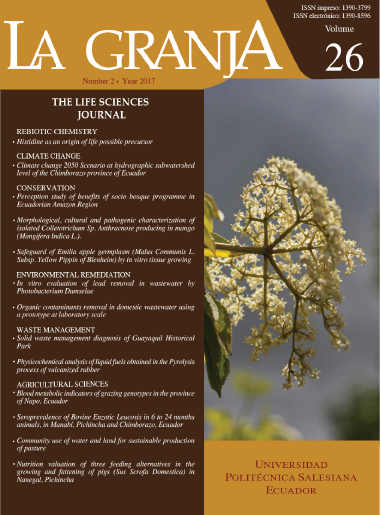
CLIMATE CHANGE SCENARIO AT SUBWATERSHED LEVEL HYDROGRAPHIC FOR THE YEAR 2050 OF THE CHIMBORAZO PROVINCE OF ECUADOR
Article Sidebar
Published:
2017-09-01
Keywords:
Climatic scenarios, vulnerability, Chimborazo, subbasin.
Main Article Content
Abstract
The present study was realized in the Province of Chimborazo-equator by the intention of establishing a scene of
climate change for the year 2050, in order to implement public policies in the Plan of Development and Territorial
Classification that they help to reduce the vulnerability of the population before the climatic risks. For it, information
was analyzed to level of hydrographic subbasins by a spatial resolution of 1 km2 in a scene of radiation of 2,6 RCP, it
corresponds to a Global Model of Traffic (GCM) named MIROC-ESM-CHEM. In the definition of the scene, information
was in use to a scale 1:4000000 more detailed generated byWorldClim since the climatic available information of
models as PRECIS, TL959 generated for the Ecuador, they have a very low detail with a cricket of 50 km2, it climbs
1:282 800 000, which for the case of the province it is great bounding one considering that of the information obtained
results for level of subbasins. On having compared the current scene and that of climate change for the year 2050, in
the information climatic variations were observed principally reduction of the rainfall in the subbasins: Rio Namangoza,
Rio Patate and Rio Chambo; as well as, an increase of the minimal and maximum temperature in the subbasin
Rio Namangoza
climate change for the year 2050, in order to implement public policies in the Plan of Development and Territorial
Classification that they help to reduce the vulnerability of the population before the climatic risks. For it, information
was analyzed to level of hydrographic subbasins by a spatial resolution of 1 km2 in a scene of radiation of 2,6 RCP, it
corresponds to a Global Model of Traffic (GCM) named MIROC-ESM-CHEM. In the definition of the scene, information
was in use to a scale 1:4000000 more detailed generated byWorldClim since the climatic available information of
models as PRECIS, TL959 generated for the Ecuador, they have a very low detail with a cricket of 50 km2, it climbs
1:282 800 000, which for the case of the province it is great bounding one considering that of the information obtained
results for level of subbasins. On having compared the current scene and that of climate change for the year 2050, in
the information climatic variations were observed principally reduction of the rainfall in the subbasins: Rio Namangoza,
Rio Patate and Rio Chambo; as well as, an increase of the minimal and maximum temperature in the subbasin
Rio Namangoza
Article Details
Section
Scientific Article
Universidad Politécnica Salesiana of Ecuador preserves the copyrights of the published works and will favor the reuse of the works. The works are published in the electronic edition of the journal under a Creative Commons Attribution/Noncommercial-No Derivative Works 3.0 Ecuador license: works can be copied, used, disseminated, transmitted and publicly displayed.
The undersigned author partially transfers the copyrights of this work to Universidad Politécnica Salesiana of Ecuador for the printed edition.
References
Cuesta, F., Peralvo, M., y Valarezo, N. (2009). Los bosques montanos de los Andes Tropicales. Una evaluación regional de su estado de conservación y de su vulnerabilidad a efectos del cambio climático. Serie Investigación y Sistematización #5. Program Regional ECOBONA- INTERCOOPERATION. Quito.
Feeley, K., & Silman, M. (2010). Land-use and climate change effects on population size and extinction risk of Andean plants. Global Change Biology, 16, 3215–3222.
GADPCH, Gobierno Autónomo Descentralizado de la Provincia de Chimborazo. (2012). Plan de desarrollo y ordenamiento territorial de Chimborazo - Síntesis. Riobamba.
GADPCH, Gobierno Autónomo Descentralizado de la Provincia de Chimborazo. (2014). Índice Ombrotérmico para la provincia de Chimborazo en un escenario de cambio climático al año 2050. Ecociencia-Riobamba.
Huettmann, F., Leathwick, R., Lehmann, A., Li, J., Lohmann, L.G., Loiselle, B.A., Manion, G., Moritz, C., Nakamura, M., Nakazawa,Y., Overton, J.McC., Peterson, A.T., Phillips, J., Richardson, K., Scachetti- Pereira, R., Schapire, E., Soberon, J., Williams, S., Wisz, M., Zimmermann, E. 2006. Novel methods improve prediction of species' distributions from occurrence data. Ecography 29:129-151.
Hijmans, R.J., S.E. Cameron, J.L. Parra, P.G. Jones, and A. Jarvis. (2005a). Very high resolution interpolated climate surfaces for global land areas. International Journal of Climatology 25:1965.
Hijmans, R.J., L. Guarino, A. Jarvis, R. O'Brien, P. Mathur, C. Bussink, M. Cruz, I. Barrantes, and E. Rojas. (2005b). DIVA-GIS Version 5.2, Manual.
IPCC, 2013: Climate Change 2013: The Physical Science Basis. Contribution of Working Group I to the Fifth Assessment Report of the Intergovernmental Panel on Climate Change [Stocker, T.F., D. Qin, G.- K. Plattner, M. Tignor, S.K. Allen, J. Boschung, A. Nauels, Y. Xia, V. Bex and P.M. Midgley (eds.)]. Cambridge University Press, Cambridge, United Kingdom and New York, NY, USA, 1535 pp.
Jiménez, S. Castro, L., Yépez, J., y Wittmer, C. (2011). Impacto del cambio climático en la agricultura de subsistencia en el Ecuador. Fundación Carolina. Serie Avances de Investigación nº 66.
Laderach, P., A. Eitzinger, O. Ovalle, J. Ramírez and A. Jarvis. (2010). Climate Change Adaptation and
Mitigation in the Kenyan Coffee. Final report.
La Frenierre J. (2010). Evaluation of Glacier Change on Volcán Chimborazo 1986-2010., Riobamba-Ecuador.. As Derived from Landsat TM., Pp. 21
MAE. Ministerio del Ambiente del Ecuador. (2011). Segunda Comunicación Nacional sobre Cambio Climático. PNUD. Quito. Ecuador.
MAE, Ministerio del Ambiente del Ecuador. (2013). Mapa de Ecosistemas del Ecuador Continental. Ministerio del Ambiente. Quito.
Ministerio del Ambiente. (2011). Segunda Comunicación Nacional sobre Cambio Climático. Quito: Proyecto GEF/PNUD/MAE Segunda Comunicación Nacional sobre Cambio Climático.
Phillips, S.J., R.P. Anderson, and R.E. Schapire. 2006. Maximum entropy modeling of species geographic distributions. Ecological Modelling 190:231-259.
Ramirez & Jarvis. 2010. Disaggregation of Global Circulation Model Outputs. Disaggregation of Global
Circulation Model Outputs. http://gisweb.ciat.cgiar.org/GCMPage/
Tukey J.W. (1977) Exploratory data analysis. Addison-Wesley Publishing Co., Reading, MA.
WorldClim. (2013). Información de clima a nivel mundial. Disponible en: http://worldclim.org/version2
Feeley, K., & Silman, M. (2010). Land-use and climate change effects on population size and extinction risk of Andean plants. Global Change Biology, 16, 3215–3222.
GADPCH, Gobierno Autónomo Descentralizado de la Provincia de Chimborazo. (2012). Plan de desarrollo y ordenamiento territorial de Chimborazo - Síntesis. Riobamba.
GADPCH, Gobierno Autónomo Descentralizado de la Provincia de Chimborazo. (2014). Índice Ombrotérmico para la provincia de Chimborazo en un escenario de cambio climático al año 2050. Ecociencia-Riobamba.
Huettmann, F., Leathwick, R., Lehmann, A., Li, J., Lohmann, L.G., Loiselle, B.A., Manion, G., Moritz, C., Nakamura, M., Nakazawa,Y., Overton, J.McC., Peterson, A.T., Phillips, J., Richardson, K., Scachetti- Pereira, R., Schapire, E., Soberon, J., Williams, S., Wisz, M., Zimmermann, E. 2006. Novel methods improve prediction of species' distributions from occurrence data. Ecography 29:129-151.
Hijmans, R.J., S.E. Cameron, J.L. Parra, P.G. Jones, and A. Jarvis. (2005a). Very high resolution interpolated climate surfaces for global land areas. International Journal of Climatology 25:1965.
Hijmans, R.J., L. Guarino, A. Jarvis, R. O'Brien, P. Mathur, C. Bussink, M. Cruz, I. Barrantes, and E. Rojas. (2005b). DIVA-GIS Version 5.2, Manual.
IPCC, 2013: Climate Change 2013: The Physical Science Basis. Contribution of Working Group I to the Fifth Assessment Report of the Intergovernmental Panel on Climate Change [Stocker, T.F., D. Qin, G.- K. Plattner, M. Tignor, S.K. Allen, J. Boschung, A. Nauels, Y. Xia, V. Bex and P.M. Midgley (eds.)]. Cambridge University Press, Cambridge, United Kingdom and New York, NY, USA, 1535 pp.
Jiménez, S. Castro, L., Yépez, J., y Wittmer, C. (2011). Impacto del cambio climático en la agricultura de subsistencia en el Ecuador. Fundación Carolina. Serie Avances de Investigación nº 66.
Laderach, P., A. Eitzinger, O. Ovalle, J. Ramírez and A. Jarvis. (2010). Climate Change Adaptation and
Mitigation in the Kenyan Coffee. Final report.
La Frenierre J. (2010). Evaluation of Glacier Change on Volcán Chimborazo 1986-2010., Riobamba-Ecuador.. As Derived from Landsat TM., Pp. 21
MAE. Ministerio del Ambiente del Ecuador. (2011). Segunda Comunicación Nacional sobre Cambio Climático. PNUD. Quito. Ecuador.
MAE, Ministerio del Ambiente del Ecuador. (2013). Mapa de Ecosistemas del Ecuador Continental. Ministerio del Ambiente. Quito.
Ministerio del Ambiente. (2011). Segunda Comunicación Nacional sobre Cambio Climático. Quito: Proyecto GEF/PNUD/MAE Segunda Comunicación Nacional sobre Cambio Climático.
Phillips, S.J., R.P. Anderson, and R.E. Schapire. 2006. Maximum entropy modeling of species geographic distributions. Ecological Modelling 190:231-259.
Ramirez & Jarvis. 2010. Disaggregation of Global Circulation Model Outputs. Disaggregation of Global
Circulation Model Outputs. http://gisweb.ciat.cgiar.org/GCMPage/
Tukey J.W. (1977) Exploratory data analysis. Addison-Wesley Publishing Co., Reading, MA.
WorldClim. (2013). Información de clima a nivel mundial. Disponible en: http://worldclim.org/version2