

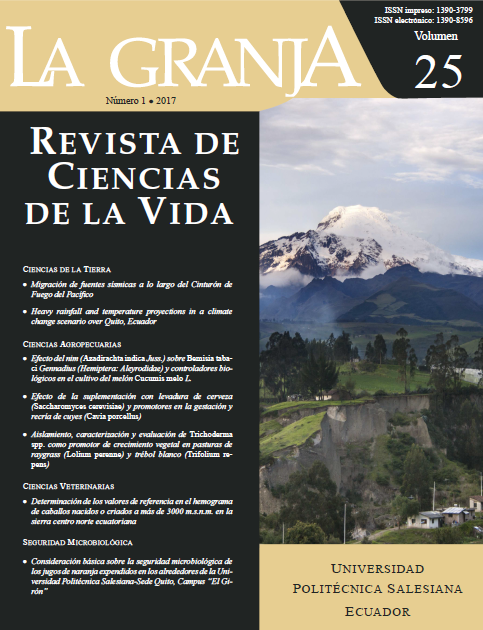
ISOLATION, CHARACTERIZATION AND EVALUATION OF Trichoderma spp. AS PROMOTER OF PLANT GROWTH IN PASTURES OF RAYGRASS (Lolium perenne) AND WHITE CLOVER (Trifolium repens)
Article Sidebar
Main Article Content
Abstract
The genus Trichoderma fungi have been widely used in agricultre as biological control method due to their capacity to excret exogenous enzymes allowing them to act as a biopesticide. This fungi has the ability to grow in diverse habitats and they are often finded in soil and decaying matter. Its role as a plant growth promoter is due to their ability to rapidly colonize the roots of the plant, protecting them from the attact of phytopathogenic fungi. This proces results in increased growth and exudation of phytohormones or solubilizing phosphates as Fe, Mn, Mg. The objective of this study was to isolate native strains of Trichoderma spp. present in the soil of the farm “La Alegría” located in the canton Pedro Moncayo, for subsequent evaluation as promoters of growth in raygrass and white clover. The isolated strains were identified as Trichoderma harzianum and Trichoderma viride. The effect as growth promoter was in previously established pasture fields. We made three cuts with a 45 days period, after each cut we fertilized the pastures with liquid solutions of the fungus at a concentration of 106 , organic matter (compost 45% MO) and chemical fertilizer (Fertiforraje). The treatments that work the best were the T1 with green matter of 12,72 MT/Ha/cut and T6 with an average of 11,55 MT/ha/cut, compared with the controller and the chemical fertilizer.
Article Details
Universidad Politécnica Salesiana of Ecuador preserves the copyrights of the published works and will favor the reuse of the works. The works are published in the electronic edition of the journal under a Creative Commons Attribution/Noncommercial-No Derivative Works 3.0 Ecuador license: works can be copied, used, disseminated, transmitted and publicly displayed.
The undersigned author partially transfers the copyrights of this work to Universidad Politécnica Salesiana of Ecuador for the printed edition.