

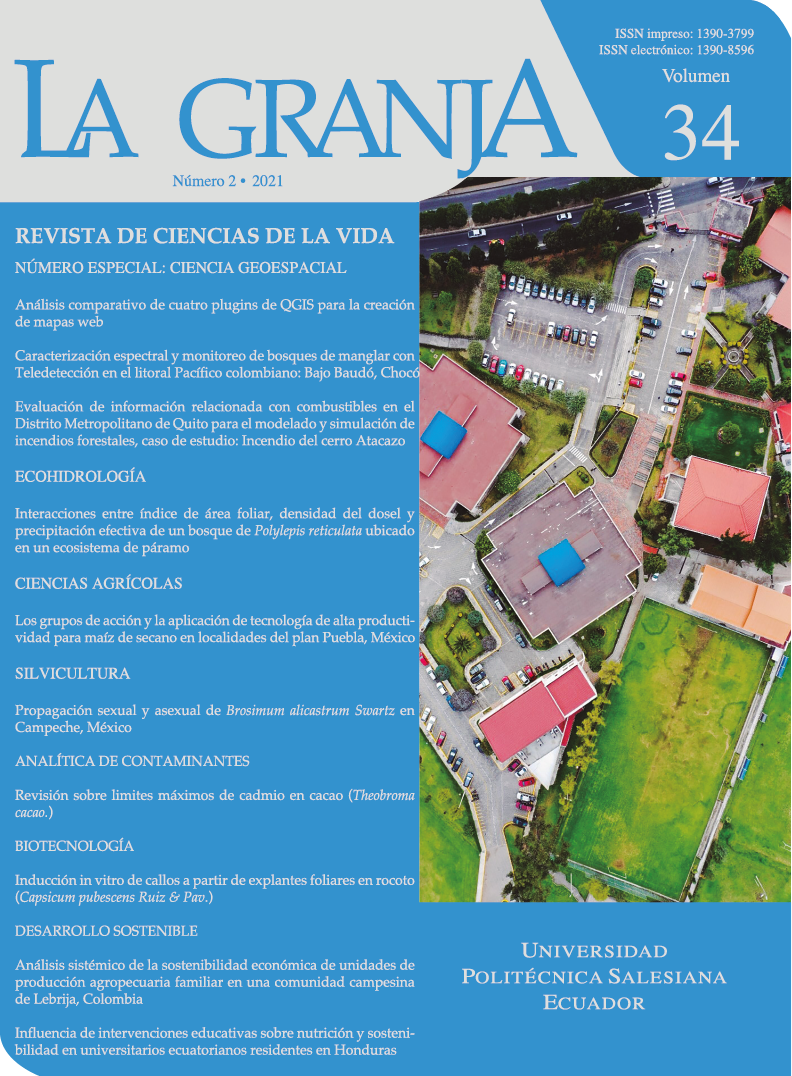
Análisis comparativo de cuatro plugins de QGIS para la creación de mapas web
Barra lateral del artículo
Contenido principal del artículo
Resumen
QGIS es un software gratuito y de código abierto que permite visualizar, editar y analizar datos georreferenciados. Es un software de Sistema de Información Geográfica (SIG) compuesto por herramientas que permiten manipular la información geográfica y crear mapas que ayuden a obtener una mejor comprensión y organización de los datos geoespaciales. Desafortunadamente, los mapas que se crean directamente en el software de escritorio GIS no se pueden transferir automáticamente a un sitio web. Por lo ranto, esta investigación tuvo como objetivo comparar las capacidades de publicación en complementos de QGIS, y crear mapas web. El estudio analiza cuatro plugins de QGIS (QGIS2Web, QGIS Cloud, GIS Cloud Publisher y Mappia Publisher), realizando una comparativa entre ellos, considerando sus ventajas y desventajas, los planes gratuitos y de suscripción, las herramientas que ofrece cada plugin y otros aspectos genéricos. Los cuatro complementos se probaron en un caso de estudio específico para obtener automáticamente los diferentes mapas web. Este estudio podría ayudar a los usuarios a elegir las herramientas más adecuadas para publicar mapas web en el software QGIS.
Detalles del artículo
Universidad Politécnica Salesiana of Ecuador preserves the copyrights of the published works and will favor the reuse of the works. The works are published in the electronic edition of the journal under a Creative Commons Attribution/Noncommercial-No Derivative Works 3.0 Ecuador license: works can be copied, used, disseminated, transmitted and publicly displayed.
The undersigned author partially transfers the copyrights of this work to Universidad Politécnica Salesiana of Ecuador for the printed edition.
Referencias
Bhatia, T. y col. (2018). «Web GIS Development using Open Source Leaflet and Geoserver Toolkit». En: Int. J. Comput. Sci. Technol 9.3. Online: https://bit.ly/3ej0Wgq
Bing Maps (2021). «Bing Maps». Accessed 25 september 2020. Online: https://binged.it/3h52216
Cartwright, William y col. (2001). «Geospatial information visualization user interface issues». En: Cartography and Geographic Information Science 28.1, 45-60. Online: https://bit.ly/3xJa5qh
Chen, P. y Thanh C. Nguyen (2017). «Integrating web map service and building information modeling for location and transportation analysis in green building certification process». En: Automation in Construction 77, 52-66. Online: https://bit.ly/3nPi8NL
DGT - dgTerritório (2015). «Direão-Geral do Território». Accessed on 22 April 2015. Online: https://bit.ly/3xOsp1
Duarte, L., J. Espinha y A. Teodoro (2019). «An Open Source GIS-Based Application for the Assessment of Groundwater Vulnerability to Pollution». En: Environments 6.7, 86. Online: https://bit.ly/3xPTdxU
Duarte, L., P. Silva y A. Teodoro (2018). «Development of a QGIS plugin to obtain parameters and elements of plantation trees and vineyards with aerial photographs». En: ISPRS International Journal of Geo-Information 7.3, 109. Online: https://bit.ly/3toihZq
Duarte, L. y col. (2016). «Assessing soil erosion risk using RUSLE through a GIS open source desktop and web application». En: Environmental monitoring and assessment 188.6, 351. Online: https://bit.ly/33jGHJi
Duarte, L. y col. (2018). «QPhenoMetrics: An open source software application to assess vegetation phenology metrics». En: Computers and Electronics in Agriculture 148, 82-94. Online: https://bit.ly/3thbKQo
GIS Cloud (2020). «Real-Time mapping». Accessed 25 september 2020. Online: https://bit.ly/3vNColk
Garnero, G. e I. Vigna (2018). «GIS Instruments in Support of the Forestry Activities: A Case Study». En: Journal of Agricultural Science and Technology B 8, 388-395. Online: https://bit.ly/2PTN179
Geoapify (2020). «Leaflet vs OpenLayers. What to choose?» Accessed 25 september 2020. Online: https://bit.ly/3uot33n
Gharbi, A. y S. Haddadi (2020). «Application of the mobile GIS for the improvement of the knowledge and the management of the road network». En: Applied Geomatics 12.1, 23-39. Online: https://bit.ly/33mlH4x
GitHub (2020). «Where the world builds software». Accessed 25 september 2020. Online: https://bit.ly/3eiDuzL
Google Maps (2020). «Google Maps». Accessed 25 september 2020. Online: https://bit.ly/3nPGlDz
Hossain, M. y H. Meyer (2018). «Concepts and Methods of Embedding Statistical Data into Maps». En: International Journal of Scientific and Research Publications (IJSRP) 8.5, 2250-3153. Online: https://bit.ly/3nSRcfK
ICNF (2015). «Instituto da Conservaçãda Natureza e das Florestas». Accessed on 22 April 2015. Online: https://bit.ly/3b4FTfE
Leaflet for R (2020). «Leaflet for R». Accessed 25 september 2020. Online: https://bit.ly/3nQfSWp
Leaflet (2020). «Leaflet, an open-source JavaScript library for mobile-friendly interactive maps». Accessed 25 september 2020. Online: https://bit.ly/3b8nsX8
MapBox (2020). «Maps and location for developers». Accessed 25 september 2020. Online: https://bit.ly/3f0hTeq
MappiaEarth (2020). «MappiaEarth». Accessed 25 september 2020. Online: https://bit.ly/3ejluW2. Parker, C., A.
May y V. Mitchell (2013). «The role of VGI and PGI in supporting outdoor activities». En: Applied ergonomics 44.6, 886-894. Online: https://bit.ly/3h3CxwW
QGIS Cloud (2020). «QGIS Cloud». Accessed 25 september 2020. Online: https://bit.ly/3h68PYc
Stallman, P. (2007). «Why ‘Open Source’ misses the point of free software, GNU Operating System». Accessed February 2011. Online: https://bit.ly/3ti9Oap
Sukic, E. y D. Ran?ci´c (2011). «FOS GIS solutions in Web Mapping». En: Technics Technologies Education Management 6.4, 1083-1088. Online: https://bit.ly/3enhIuU
Teodoro, A. y L. Duarte (2013). «Forest fire risk maps: a GIS open source application–a case study in Norwest of Portugal». En: International Journal of Geographical Information Science 27.4, 699-720. Online: https://bit.ly/3nYoRF1
Veenendaal, B., M. Brovelli y S. Li (2017). «Review of web mapping: Eras, trends and directions». En: ISPRS International Journal of Geo-Information 6.10, 317. Online: https://bit.ly/3xSKN91