

Universal Design of Learning and and inclusion in Basic Education
Article Sidebar
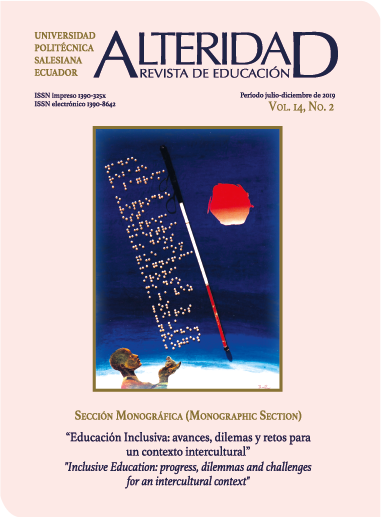
Main Article Content
Abstract
Inclusive education maintains that equity must be the target and the most precious value of current education systems. Under this premise, change and innovation in the school are inherent to such a target, in order to foster equality of opportunity. These changes, among others, affect teaching methodology and strategies. Thus, educating without exclusions will also correspond to teachers. This research will be approached from this perspective, with the objective of approaching the reality of knowledge and the use of didactic strategies that put into practice the universal design for learning (UDL) of basic education teachers. This is followed by a descriptive study using a mixed methodology that presents both quantitative and qualitative data. The final sample is 26 teachers, who work with children between the ages of 7 and 12, from 4 educational establishments: 2 Fiscal Commission, 1 Private individual and 1 Bilingual intercultural, represented in 3 natural regions of Ecuador. The main results reflect the limited knowledge of the SAD and the principles and, on the other hand, the demand of teachers for specialized training in attention to diversity and educational inclusion through the universal design of learning. The type of teacher intervention and the degree of involvement and participation of the students according to the geographical area of the country is relevant.
Article Details
Copyright: The Salesian Polytechnic University preserves the copyrights of the published articles, and favors and allows their reuse under the Creative Commons Attribution-NonCommercial-ShareAlike 3.0 Ecuador license. They may be copied, used, disseminated, transmitted and publicly displayed, provided that: i) the authorship and the original source of their publication (journal, editorial and work URL) are cited; (Ii) are not used for commercial purposes; Iii) mention the existence and specifications of this license.