

Fuzzy Logic as an evaluation tool in the university sector
Article Sidebar
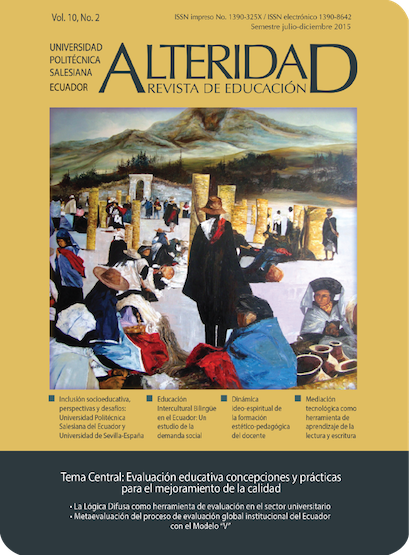
Published:
2015-12-30
Keywords:
Higher education, Fuzzy Logic, student evaluation, social values, attitudes, attitudinal assessment.
Main Article Content
Abstract
This paper presents the partial advances of a research about the application of fuzzy logic in the attitudinal evaluation in university students. It is circumscribed in the Mixed Paradigm. It uses the Grounded Theory, focus groups and interviews, in addition to techniques, instruments and fuzzy procedures, to generate, from the perspective of a purposive sample of sixteen expert professors of theTerritorial Polytechnic University “José Félix Ribas”, in Barinas state,Venezuela, an approach to the attitudinal assessment that is realized in this context.The main results so far, include the definition of relevant attitudes of the evaluation process, their relative weighting and the fuzzy scale to be used in the above mentioned assessment.
Article Details
Section
Central Theme
Authorship: The list of authors signing must include only those people who have contributed intellectually to the development of the work. Collaboration in the collection of data is not, by itself, a sufficient criterion of authorship. "Alteridad" declines any responsibility for possible conflicts arising from the authorship of the works that are published.
Copyright: The Salesian Polytechnic University preserves the copyrights of the published articles, and favors and allows their reuse under the Creative Commons Attribution-NonCommercial-ShareAlike 3.0 Ecuador license. They may be copied, used, disseminated, transmitted and publicly displayed, provided that: i) the authorship and the original source of their publication (journal, editorial and work URL) are cited; (Ii) are not used for commercial purposes; Iii) mention the existence and specifications of this license.
Copyright: The Salesian Polytechnic University preserves the copyrights of the published articles, and favors and allows their reuse under the Creative Commons Attribution-NonCommercial-ShareAlike 3.0 Ecuador license. They may be copied, used, disseminated, transmitted and publicly displayed, provided that: i) the authorship and the original source of their publication (journal, editorial and work URL) are cited; (Ii) are not used for commercial purposes; Iii) mention the existence and specifications of this license.