

The service learning values map
Article Sidebar
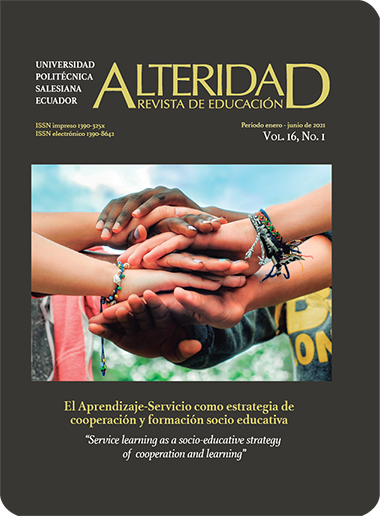
Main Article Content
Abstract
Despite the fact that the specialized bibliography recognizes service learning as a relevant methodologyfor values education, a sufficiently complete list of the plurality of values that it activates, is not yet available.The objective of this article is to build a reliable map of the values that service learning proposes. In orderto achieve it, the levels of learning that overlap in a complex educational practice will be defined and thenthe values that works at each level of service-learning practices will be determined. To achieve this, a rationalreconstruction work based on the reciprocal optimization achieved between a selection of good service learning experiences and the theory of moral practices and service-learning has been carried out. This methodology has allowed us to establish three simultaneous levels of learning —practice, actions and tasks— as well as a list of the values that crystallize in each of them: a complete map of the variety and richness of values that are put into play in service learning. A result that, in the processes of teacher training, will help to raise awareness of the moral strength of this methodology and to activate it during their professional performance.
Article Details
Copyright: The Salesian Polytechnic University preserves the copyrights of the published articles, and favors and allows their reuse under the Creative Commons Attribution-NonCommercial-ShareAlike 3.0 Ecuador license. They may be copied, used, disseminated, transmitted and publicly displayed, provided that: i) the authorship and the original source of their publication (journal, editorial and work URL) are cited; (Ii) are not used for commercial purposes; Iii) mention the existence and specifications of this license.
References
Bourdieu, P. (1980). Le sens pratique. Les editions de Minuit.
Bourdieu, P. (1997). Meditations pascaliennes. Éditions du Seuil.
Cela-Conde, C.J. (1989). El naturalismo contemporáneo: de Darwin a la sociobiología. En V. Camps (Ed.), Historia de la ética. 3. La ética contemporánea (pp. 601-634). Editorial Crítica.
De Waals, F. (2007). Primates y filósofos. La evolución de la moral del simio al hombre. Paidós.
Dewey, J. (1964). Naturaleza humana y conducta. Fondo de Cultura Económica.
Dewey, J. (2008). Teoría de la valoración. Editorial Biblioteca Nueva.
Eyler, J., & Giles, D.E. (1999). Where’s the Learning in Service-Learning? Jossey-Bass
Freinet, C. (1972). La educación moral y cívica. Laia.
Frondizi, R. (1958). ¿Qué son los valores? Fondo de Cultura Económica.
Frondizi, R. (1977). Introducción a los problemas fundamentales del hombre. Fondo de Cultura Económica.
Furco, A. (2002). Is service-Learning really better than community service? In A. Furco, & S.H. Billing (Ed.), Service-Learning. The essence of the Pedagogy (pp. 23-50). Information Age Publishing.
GREM (2015) Rúbrica para la autoevaluación y la mejora de los proyectos de aprendizaje-servicio. Fundació Jaume Bofill. https://bit.ly/33FhY2F
Habermas, J. (1985). Conciencia moral y acción comunicativa. Península.
MacIntyre, A. (1987). Tras la virtud. Crítica.
Martín, X., & Rubio, L. (2010). Prácticas de ciudadanía. Octaedro.
Martín, X. (2016). Proyectos con alma. Trabajo por proyectos con servicio a la comunidad. Barcelona, Graó.
Miller, P.J., & Goodnow, J.J. (1995). Cultural practices: Toward an Integration of Culture and Development. In J.J. Goodnow, P.J. Miller, & F. Kessel (Ed.), Cultural Practices as Contexts for Development (pp. 5-16). Jossey-Bass Publishers.
Novak, J.D., & Gowin, D.B. (1988): Aprendiendo a aprender. Martínez Roca.
Novak, J.D. (1998): Conocimiento y aprendizaje. Los mapas conceptuales como herramientas facilitadoras para escuelas y empresas. Alianza Editorial.
Perry, R.B. (1950). General Theory of Value. Harvard University Press.
Piaget, J. (1999). De la pedagogía. Paidós.
Puig, J.M. (2003). Prácticas morales. Una aproximación a la educación moral. Paidós.
Puig, J.M. (Coord.) (2009). Aprendizaje servicio (ApS). Educación y compromiso cívico. Graó.
Puig, J.M. (Coord.) (2015). 11 ideas clave. ¿Cómo realizar un proyecto de aprendizaje servicio? Graó.
Puig, J. (2016). Aprendizaje servicio y educación en valores. Convives, (16), 12-19. https://bit.ly/2JxGcVp
Rogoff, B. (1993). Aprendices del pensamiento. El desarrollo cognitivo en el contexto social. Paidós.
Scheler, M. (1941). Ética. Revista de Occidente.
Tapia, N. (2001). La solidaridad como pedagogía. El aprendizaje-servicio en la escuela. Ciudad Nueva.
Tapia, N. (2006). Aprendizaje y servicio solidario. En el sistema educativo y las organizaciones juveniles. Ciudad Nueva.
Tomasello, M. (2010). ¿Por qué cooperamos? Katz.
Tomasello, M. (2016). A Natural History of Human Morality. Harvard University Press.
Vygotsky, L.S. (1979). El desarrollo de los procesos psicológicos superiores. Crítica.
Wenger, E. (2001). Comunidades de práctica. Aprendizaje, significado e identidad. Paidós.
Wertsch, J.V. (1988). Vygotsky y la formación social de la mente. Paidós.
Wilson, E.O. (2012). La conquista social de la tierra. Debate.